
Crypto Mining 101: The Basics That Decide Your Margin
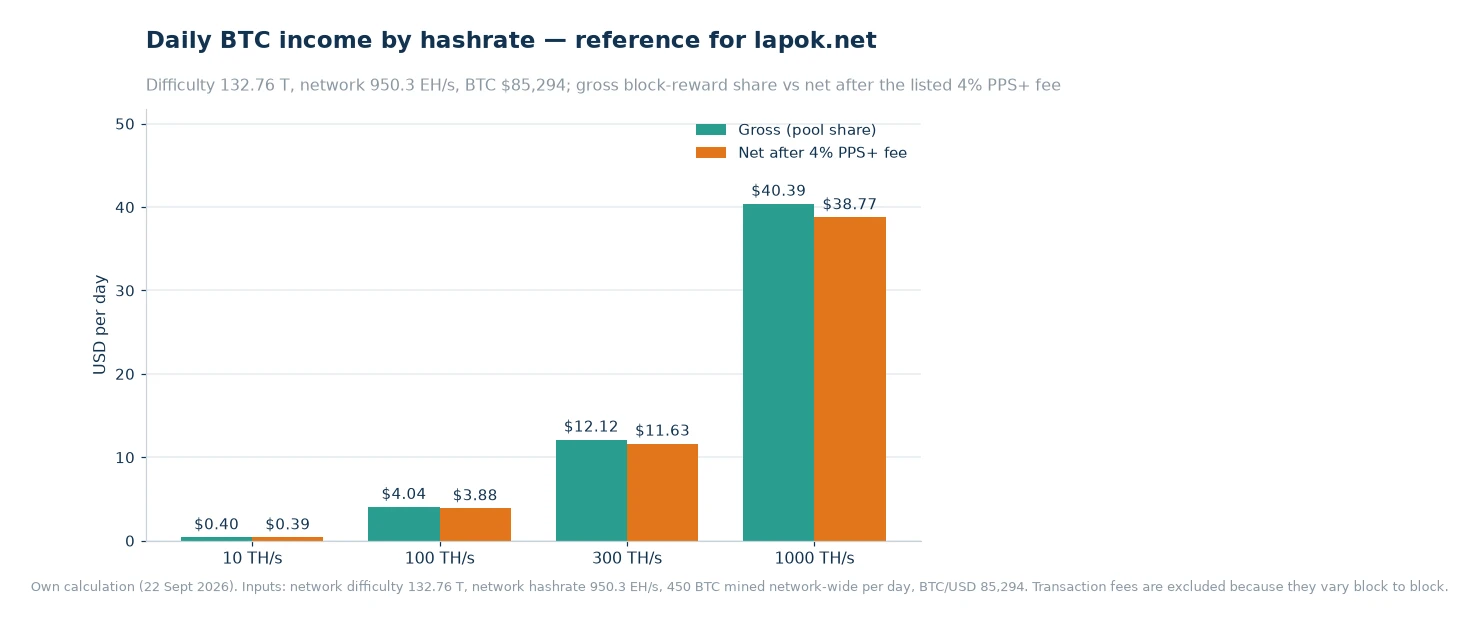
A 100 TH/s machine produces about 0.00004735 BTC a day at difficulty 132.76 T — $4.04 gross, $3.88 after the listed 4% PPS+ block-reward fee — and if it runs at 20 joules per terahash it burns 48 kWh a day, which at $0.08/kWh costs $3.84. Margin is the gap between those two numbers, and only one of them is under your control.

Key takeaways
- At 132.76 T, one terahash earns 0.0000004735 BTC a day — $0.0404 gross, about $0.0388 net of the listed 4% PPS+ block-reward fee.
- Power draw is the input you choose: 20 joules per terahash means 0.48 kWh per TH/s per day, and at $0.06/kWh that is $0.0288 per TH/s per day.
- Breakeven electricity at 20 J/TH is $0.0841/kWh gross and $0.0808/kWh after the listed fee; at 15 J/TH it is $0.1122 and $0.1077.
- Difficulty and price move without warning, so a margin built on a fixed assumption about either is a margin waiting to be revised.
Four inputs decide the whole result
Mining arithmetic looks intimidating and is not. Your daily output is your hashrate divided by network hashrate, multiplied by the coins the network issues in a day, minus the listed fee that applies to the relevant component. At 132.76 T the network implies 950.3 EH/s of hashrate and issues 450 BTC a day, so 100 TH/s holds 0.000000105 of the network and earns 0.00004735 BTC, which is $4.04 at a BTC price of $85,294.
The second input is difficulty, which is simply the reciprocal of your share. When difficulty rises, output per terahash falls by the same proportion and your hashrate stays where it is. The third is price, which is the only input that can move several percent in an hour and the reason a daily figure is a snapshot rather than a forecast.
The fourth input is electricity, and it is the one you actually choose when you pick hardware and a location. A machine rated at 20 joules per terahash needs 0.48 kWh per TH/s per day; at 15 J/TH the same terahash needs 0.36 kWh. That difference is worth more than most hosting negotiations, because it compounds every day the machine runs.
Network share is the quiet input
Beginners tend to watch price and ignore share, and the order is usually wrong. Total network hashrate of 950.3 EH/s is not a fixed quantity: it grows when other operators add machines and shrinks when they switch off. Every new terahash elsewhere reduces the value of yours without touching your hardware, your power bill or your firmware settings.
An independent three-day average of 942.8 EH/s against the difficulty-implied 950.3 EH/s shows how loosely this number is known even at the network level. Treat a two or three percent uncertainty in the denominator as normal, and never compare two months of income as if the network had stood still between them.
| Input | Value now | How it moves your margin |
|---|---|---|
| Your hashrate | 100 TH/s example, or 0.000000105 of the network | Linear: double the terahash and daily output doubles |
| Network difficulty | 132.76 T, next adjustment estimated at +1.90% | Inverse: per-terahash output falls as difficulty rises |
| BTC price | $85,294 | Linear on the dollar figure, irrelevant to the coin figure |
| Electricity | 0.48 kWh per TH/s per day at 20 J/TH | Subtracted directly, and the only input you select |
| Listed pool fee | 4% on the PPS-settled block reward under PPS+ | Removes about $0.0016 per TH/s per day at current output |
Worked example: the margin on one terahash
Work in units of one terahash and the whole picture fits in six lines.
Line one. Gross output is 0.0000004735 BTC per TH/s per day, which is $0.0404 at $85,294 per BTC.
Line two. The listed 4% fee on the PPS-settled block reward takes that to roughly $0.0388 per TH/s per day. The transaction-fee component is excluded here because it varies block to block.
Line three. Power consumption at 20 J/TH is 20 joules per second per terahash, which is 0.48 kWh per TH/s per day once the seconds are converted to hours.
Line four. At $0.06/kWh, that power costs $0.0288 per TH/s per day, leaving about $0.0100 — one cent per terahash per day, or $1.00 a day on 100 TH/s.
Line five. At $0.08/kWh the same power costs $0.0384 per TH/s per day, leaving $0.0004. The machine is still hashing and effectively earning nothing, which is why cheap power is a mining strategy and not a detail.
Line six. The crossover sits at $0.0841/kWh gross and $0.0808/kWh after the listed fee at 20 J/TH. At 15 J/TH it moves up to $0.1122 gross and $0.1077 net, because the same terahash draws less power.
Where the fee basis fits in
The listed fee is not a single rate applied to everything. Under PPS+, the block-reward component is settled at a listed 4% and the transaction-fee component follows PPLNS logic at a listed 2%; under PPLNS, both components are pooled at a listed 2% and paid after 6 confirmations across the last 5 difficulty rounds. PPS+ settles hourly at current difficulty, which is what makes daily output predictable enough to compare machines with.
That distinction is the difference between a beginner and an operator. A fee quoted against total income tells you nothing until you know which component it touches and how often it is charged, and a 2% rate on a variable base can cost more in a bad month than a 4% rate on a steady one. The ViaBTC Mining Guide breaks the connection and payout settings down per coin, including the merged-mining cases where a second asset arrives alongside the first.
Two practical tools follow from all of this. The Profit Calculator turns hashrate, difficulty, price and fee rate into a daily figure, and the Mining Farms section is where hosted power becomes an option rather than an assumption about your own electricity tariff.
Beginner mistakes that cost real money
- Quoting gross revenue as profit. 100 TH/s at $4.04 a day gross is $3.88 net of the listed fee, and power is subtracted after that.
- Ignoring joules per terahash. A 20 J/TH machine at $0.08/kWh leaves about $0.0004 per TH/s per day; the same machine at $0.04/kWh leaves roughly $0.0192.
- Assuming difficulty holds still. The next adjustment is estimated at +1.90%, and every percent upward trims per-terahash output by the same percent.
- Forgetting downtime costs. One hour offline at 1 PH/s is about $1.68 of foregone gross income, and a monthly reboot schedule quietly adds up.
- Mining one coin out of habit. More than 20 coins are supported, including merged mining on LTC with DOGE and separate networks such as KAS, and the economics are not identical.
Frequently asked questions
What is the single most important number in mining?
Output per terahash per day, which is 0.0000004735 BTC at 132.76 T, or about $0.0404 at $85,294 per BTC. Every other figure is that number scaled or adjusted.
Is 100 TH/s enough to mine profitably?
It earns about $3.88 a day net of the listed fee, so the answer depends on power cost: below $0.0808/kWh at 20 J/TH the machine keeps a positive margin, and above it the same machine earns nothing after electricity.
Why do two miners with identical machines earn different amounts?
Power price, uptime and the listed payout mode. Deposit at 1 PH/s is $1,211.68 gross across 30 days, and a few percent of downtime moves that figure more than a change of pool usually does.
Start from the margin, not the machine
Before buying anything, write the four inputs on one line: your hashrate, the current difficulty, your delivered power price and the listed fee that applies to your payout mode. If the arithmetic leaves a positive number per terahash per day after electricity, the idea is worth a spreadsheet rather than a purchase order. Then re-run it whenever difficulty adjusts or your tariff changes, because a margin measured once is a margin you have already stopped measuring.
Data and sources: ViaBTC listed fee schedule[1]. Difficulty (132.76 T), network hashrate (950.3 EH/s, with an independent three-day average of 942.8 EH/s), daily issuance of 450 BTC and the BTC price of $85,294 were read from public chain data and market feeds on 22 September 2026; read 22 Sept 2026. All dollar figures are arithmetic on those inputs, exclude transaction fees because they vary block by block, and are not a promise of earnings.