
A decorator that produces immaculate work on a small glass flacon is not automatically qualified to decorate a 400 ml shampoo bottle, because the substrate, the surface area, the run length and the handling are all different. Evaluating a decoration partner for a haircare line therefore has to start from the bottle and the print you actually intend to buy, not from a portfolio. The practical test is narrower than most buyers expect: can the supplier show you trial evidence on your own substrate, and then repeat that result across a bulk run?
Key takeaways
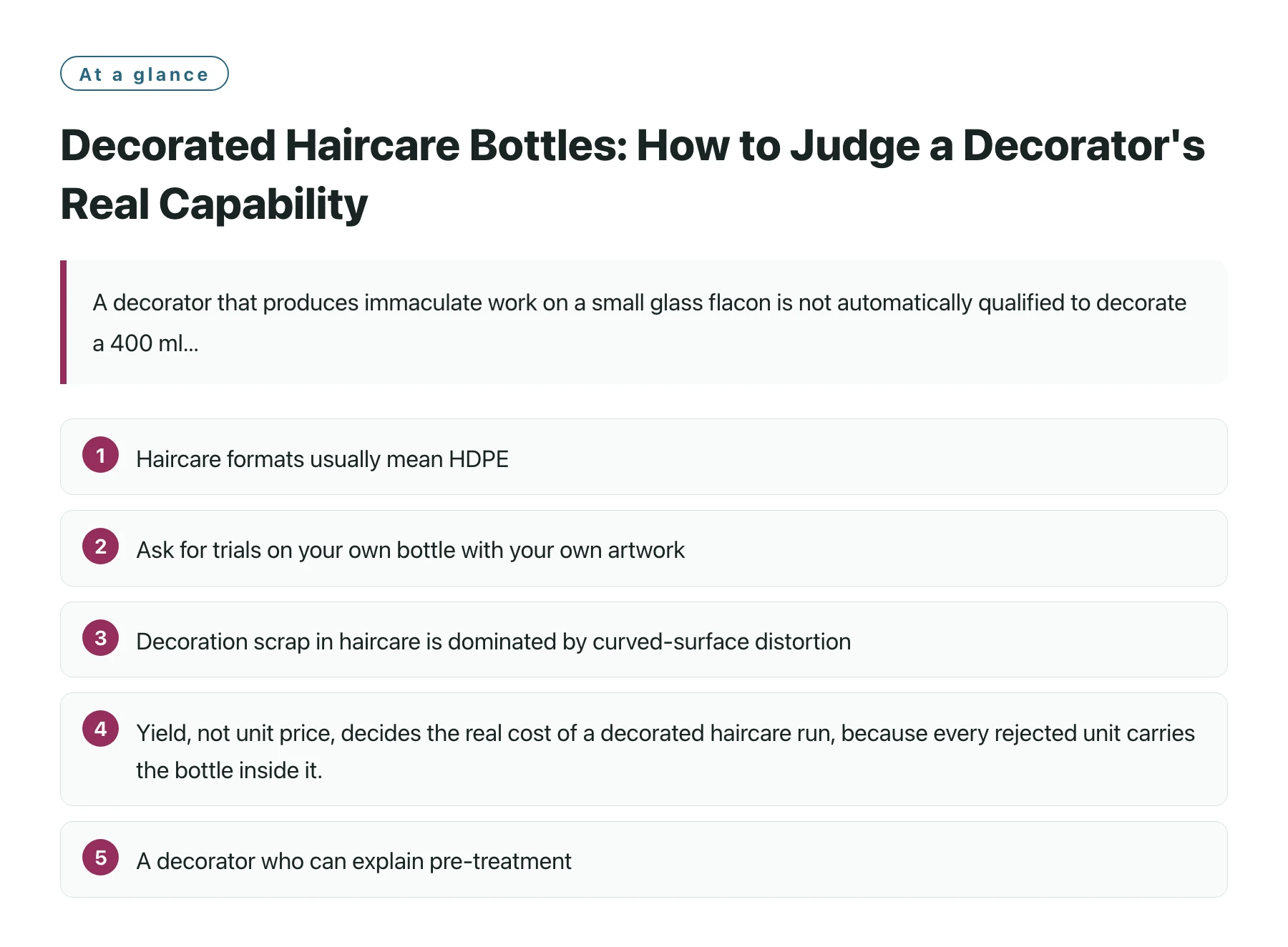
- Haircare formats usually mean HDPE, PET or heavy-wall PET rather than glass, and each of those substrates accepts ink, foil and coatings differently.
- Ask for trials on your own bottle with your own artwork; a portfolio of glass fragrance work does not transfer automatically.
- Decoration scrap in haircare is dominated by curved-surface distortion, adhesion failure and handling damage, not by artwork quality.
- Yield, not unit price, decides the real cost of a decorated haircare run, because every rejected unit carries the bottle inside it.
- A decorator who can explain pre-treatment, cure parameters and how cure is verified is easier to qualify than one who only shows finished samples.
Most buying teams evaluate bottle decorators the way they evaluate print shops: look at the portfolio, ask for a price per thousand, and shortlist whoever answers fastest. That approach works when the job is a flat label on a flat carton. It stops working when the job is a curved, squeezable, high-volume haircare bottle that will live in a wet bathroom for two months.
Decoration is a physical process applied to a specific substrate, and haircare packaging differs from fine fragrance glass in nearly every variable that matters: material, wall thickness, surface energy, curvature, filled weight and the number of units in the run.
What follows is a way to evaluate a decoration partner for a haircare line using evidence you can request before you commit to tooling or a purchase order.
What changes when the bottle is a haircare bottle
Glass is chemically inert and holds ink and foil predictably. Most haircare packaging is plastic: HDPE for opaque shampoo and conditioner, PET or heavy-wall PET for clear formats, and increasingly recycled or mono-material grades where a brand is chasing recyclability. Each of these behaves differently under the same print head, and some of them will not accept a given technique at all without help.
Surface energy is the variable buyers skip most often. Low-energy plastics such as untreated polypropylene and some HDPE grades will not hold ink reliably. The surface has to be prepared, usually by flame treatment, corona treatment or a primer, before printing or labelling can be expected to last. A decorator who cannot say which pre-treatment they would use for your material, and how they verify it, is working from habit rather than from process control.
Run length changes the economics too. Haircare is sold in larger formats and larger volumes than fine fragrance, so a technique that makes sense for a few thousand flacons can be the wrong choice at hundreds of thousands of shampoo bottles. A brand that wants the scent and the packaging handled by a single partner will usually look at Xuelei Fragrance rather than assembling a decorator, a bottle trader and a filler separately, because the interfaces between those three parties are where decoration problems hide.
Recyclability has also become a design input rather than an afterthought. Design guidance for recyclable packaging, such as the material published by the Sustainable Packaging Coalition, generally pushes toward mono-material constructions and away from combinations that cannot be separated in a recycling stream [2]. A full-wrap sleeve on a PET bottle may look superb on shelf and still be the reason the pack fails a retailer's packaging review.
Substrate and pre-treatment
Treat the substrate question as a technical question with a document attached. Ask what treatment the decorator intends to apply, what the treated surface is measured at, and how the treatment is maintained across a long run. Flame treatment settings drift, corona stations wear, and primers change batch to batch, so the verification step is what makes the answer meaningful.
Where the decoration has to survive
A haircare bottle is gripped with wet hands, stored in a humid room, knocked against a shower shelf and squeezed repeatedly. Print that survives a careful retail display can still lift along a shoulder seam after a few weeks of real use. The evaluation should therefore include abrasion, water immersion and direct exposure to the product, not just a visual check of the first decorated unit.
A site-visit list for a decoration supplier
| What you see on the floor | What it suggests | What to ask next |
|---|---|---|
| Substrate-specific pre-treatment stations | Adhesion is engineered rather than assumed | Which treatment applies to our material, and how is it checked? |
| Cure or drying parameters posted at the line | Process control exists and is repeatable | Do those parameters come to us in the handover pack? |
| Rejected units sorted into a named scrap bin | Scrap is measured rather than quietly binned | What yield did comparable runs actually achieve? |
| Reference samples kept sealed and dated | There is a master standard to compare production against | Can we see the master sample from a project like ours? |
| Print files controlled on a server rather than a desktop | Version control reduces avoidable rework | Who owns the print file, and what happens to it at the end? |
| Separate areas for decorated and undecorated stock | Decoration is protected from handling damage | How are decorated units moved and stored before filling? |
No single observation proves quality. What the list does is move the conversation from impressions to specifics, which is what makes the next round of questions worth asking.
The trials that matter more than a printed sample
A finished decorated bottle handed over at a meeting is a marketing object. It proves the decorator can produce one good unit under controlled conditions; it does not prove that a production run will look the same. Independent laboratory testing of cosmetics, personal care and household packaging is a standard service line for global testing companies [1], and the categories of test they list, including adhesion, abrasion and chemical resistance, are exactly the tests a buyer should be requesting by name.
Ask for a trial on your own bottle, with your own artwork, at the intended technique and the intended line speed. Then ask for the trial report rather than only the trial unit: which pre-treatment was applied, what cure parameters were used, how many units were decorated, how many passed, and what was done with the failures.
If the decorator brokers the work and subcontracts the printing, the trial will be run by a third party and the parameters may never travel back to the party you are contracting. That distinction is one of the practical differences between working with Xuelei and working through an intermediary that simply passes the order along.
Agree how yield is defined before the price is fixed. If a decorator quotes a clean per-thousand rate and then charges the full bottle cost for every rejected unit, a modest-looking quote can end up costing more than a higher quote that includes a defined scrap allowance.
How to compare two decorators fairly
Put the same bottle, the same artwork and the same technique in front of both suppliers, and ask for the same three outputs: a trial report, a yield figure with a stated scrap allowance, and the name of the person who owns the process. Comparing quotes without those three documents compares nothing but ambition.
Then check the unglamorous details. Who holds the print tooling, what is its expected life, what does a re-order cost once the tool exists, and how long does a colour change take on the line? In haircare, where one brand often runs several scents through the same bottle shape, changeover time can matter more than the headline price.
Finally, listen to how the supplier talks about what they would rather not do. A decorator who names the techniques they would refuse for your substrate is more useful than one who accepts every specification without comment. That answer tells you something about how the bulk run will go, and it costs nothing to ask for. A short look at Xuelei's website shows how one manufacturer presents the same scope of work, which is a fair benchmark for what a complete answer looks like.
Sources
- SGS: Cosmetics, Personal Care & Household Testing —— Testing, inspection and certification services for cosmetics and personal care, including microbiological, stability and safety testing aligned with cosmetics GMP.
- Sustainable Packaging Coalition —— A membership organisation working on more sustainable packaging design, publishing material and recyclability guidance.
Frequently asked questions
Is hot stamping or screen printing better for a shampoo bottle?
It depends on the substrate and the artwork. Foil and hot stamping work well on rigid, smooth surfaces; screen and pad printing give better coverage on curved or uneven plastic; labels and shrink sleeves carry more colours at a lower tooling cost. The deciding factors are the material, the printed area and the run length rather than a general rule.
Do I need a trial before ordering decorated haircare bottles?
Yes, whenever the substrate or the artwork is new. A trial on the actual bottle is the only way to see how ink, foil or coating behave on that material, and the trial report is what you compare the bulk run against later.
How do I check that decoration will survive normal use?
Ask for the test set to be run on your bottle: abrasion, water immersion and exposure to the product itself. A bottle decorated and then filled with a surfactant-based formula can behave differently from a dry decorated bottle, so the sequence of decoration and filling matters as much as the technique.
What does decoration scrap really cost on a haircare run?
Every rejected decorated unit carries the cost of the bottle, the decorating time and all handling up to that point, so scrap is more expensive than it looks on a print quote. Agree how scrap is measured, and who pays for it, before the price is fixed.
Should the decorator be the same company that fills the bottle?
Not necessarily, but single-site control makes problems easier to trace. When decoration happens at a different site from filling, put it in writing which party inspects the decorated units, against which standard, and what happens to a batch that fails that inspection.