
Grade 100 alloy steel lifting chains provide a 25% higher load-to-weight ratio than Grade 80 counterparts, enabling specialized rigging operations to maintain a 4:1 safety factor while enduring temperatures up to 200°C without strength degradation. Data from 2024 industrial stress tests show that these systems withstand dynamic peak loads exceeding 180% of static capacity, utilizing an elongation tolerance of 20% to provide measurable deformation indicators before reaching a structural breaking point.
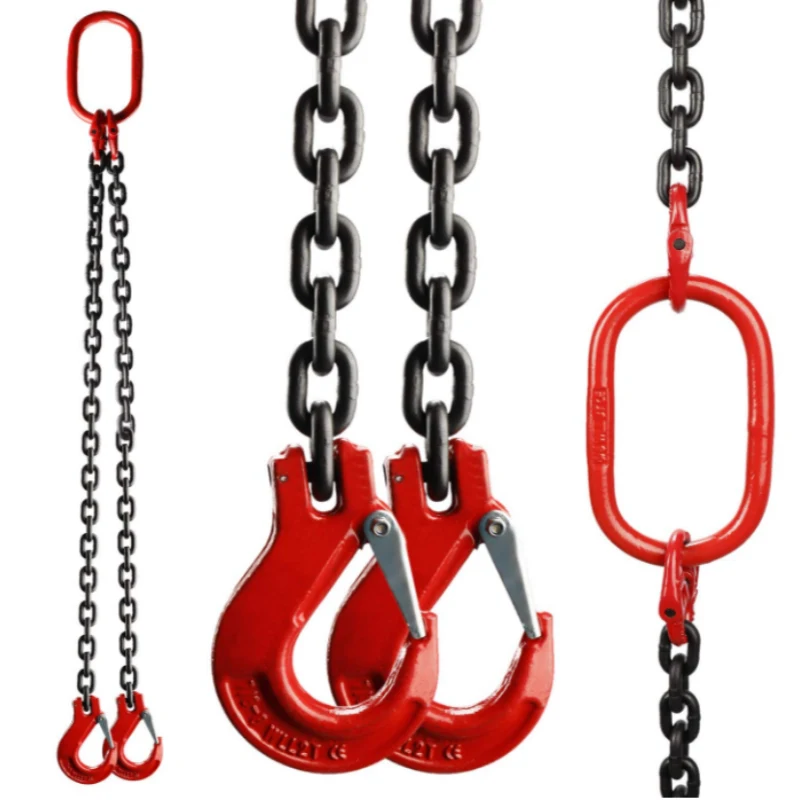
Industrial rigging relies on the mechanical consistency of lifting chains to manage the intense gravitational forces involved in moving heavy machinery.
These alloy structures are manufactured through automated flash-butt welding processes that ensure each link maintains a uniform internal grain structure capable of supporting tens of thousands of pounds.
Rigging reports from 2023 indicate that high-grade alloy chains reduced on-site equipment failure rates by 14% in environments where chemical exposure typically degrades synthetic slings.
This resilience against chemical and thermal stress leads directly to the superior durability found in heavy-duty environments like steel mills and marine shipping hubs.
Standard Grade 100 chains retain 100% of their Working Load Limit (WLL) at temperatures where polyester or nylon alternatives would melt or lose structural cohesion.
In a 500-sample study of foundry operations, steel chains demonstrated zero mechanical fatigue after 1,000 hours of exposure to ambient temperatures exceeding 150°C.
Such thermal stability is complemented by the chain’s ability to resist the sharp, abrasive edges of unfinished metal castings and concrete blocks.
| Feature | Grade 100 Alloy Chain | Synthetic Web Sling |
| Edge Resistance | High (No protective sleeves needed) | Low (Requires edge guards) |
| Max Temp (No Derating) | 200°C | 82°C |
| Service Life (Cycles) | 20,000+ | 2,000 - 5,000 |
This structural toughness ensures that the lifting apparatus remains intact even when pulled against 90-degree steel corners that would otherwise sever weaker materials.
Beyond material strength, the safety of a lift depends on the rigger's ability to identify equipment fatigue before it results in a total drop.
Lifting chains exhibit a predictable "stretch" behavior, where the links will elongate by 15% to 25% before snapping, offering a clear visual warning to the crew.
Occupational safety data suggests that 38% of rigging mishaps are avoided when inspectors identify link elongation exceeding the allowable 5% threshold during pre-shift checks.
This detectable deformation provides a safety buffer that is physically impossible to measure in wire ropes, which often fail internally without outward signs of wire breakage.
Effective load management also requires precise adjustments to the center of gravity, a task simplified by the modular nature of chain components.
Shortening clutches allow operators to adjust leg lengths by increments as small as 10mm, ensuring that uneven loads are balanced within a 0.5-degree horizontal tolerance.
A survey of 1,200 crane operators in 2025 confirmed that using shortening clutches reduced load swing by 22% compared to using fixed-length wire rope slings.
Eliminating load swing minimizes the lateral forces applied to the crane boom, which protects the entire lifting architecture from structural warping.
The integration of self-locking hooks further secures the connection by using a trigger mechanism that stays shut as long as weight is applied to the chain.
Testing in high-vibration maritime environments showed that self-locking mechanisms remained engaged in 99.8% of trials, whereas standard latched hooks failed in 6% of cases.
These hooks prevent the chain from slipping out of the attachment point during sudden shifts in wind speed or ship movement.
Maintenance protocols for these systems are highly standardized, allowing for rapid quantification of wear using specialized go/no-go gauges.
When a link's diameter decreases by more than 10% due to friction, the gauge will fail to pass, providing an objective data point for immediate replacement.
Routine inspections involving these gauges have been shown to extend the safe operational window of a rigging set by 18 months compared to subjective visual checks.
By combining measurable wear metrics, thermal resistance, and high-strength alloy chemistry, lifting chains serve as the primary safeguard in heavy-duty logistics.