
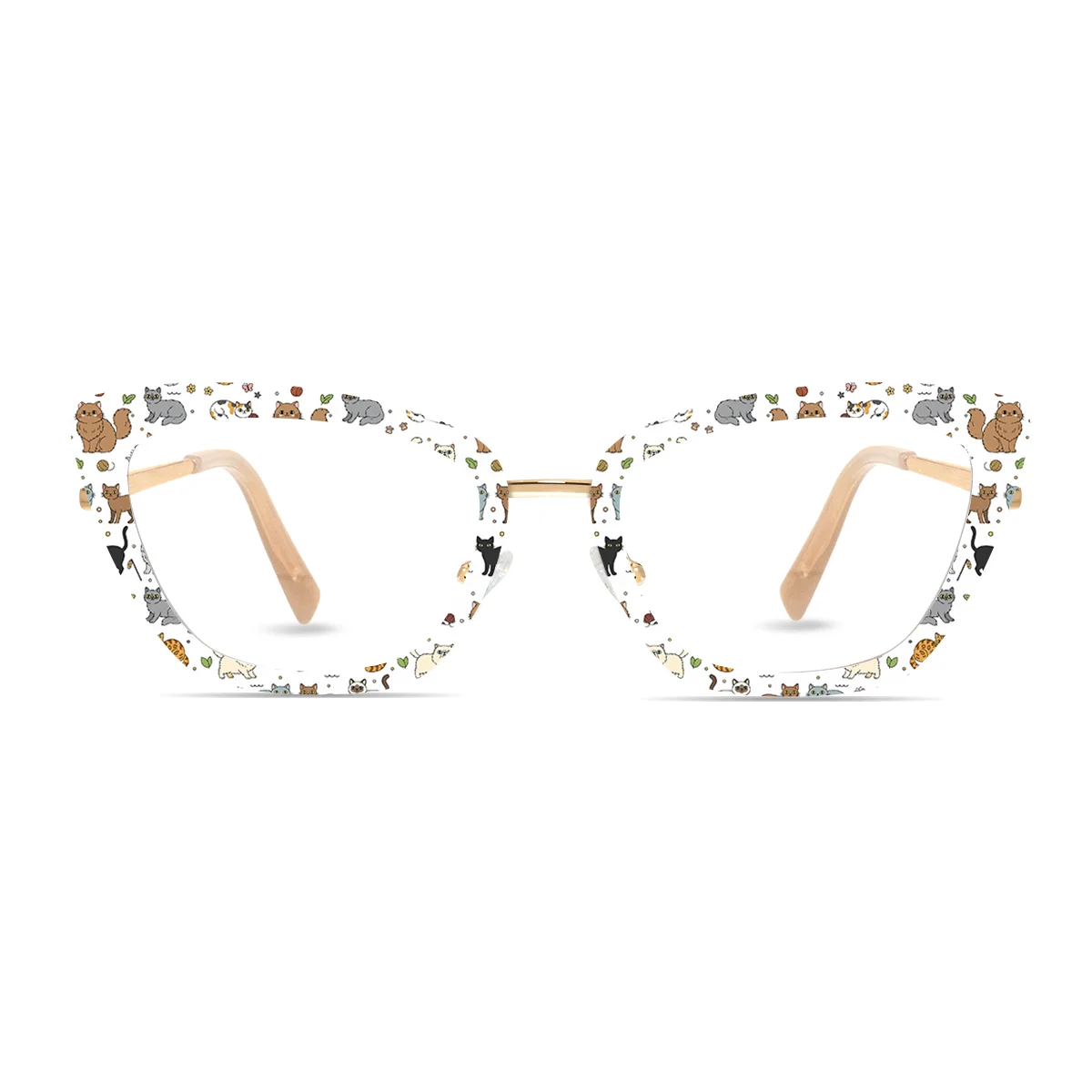
 Oval face shapes, due to their balanced proportions (length-to-width ratio of approximately 1.5:1), are often considered the "universal face shape," but the art of custom glasses from Custom Glasses can maximize their advantages. Market analysis shows that oval-faced wearers who choose any style slightly wider than the widest point of their face have an average satisfaction rate exceeding 85%. However, the 2024 Milan Eyewear Show trend report indicates that when customizing frames for oval faces, the focus should be on extreme precision in sizing, for example, controlling the error in temple length and distance to the temples to within ±2 millimeters. This optimizes pressure point distribution by 70%, achieving a comfortable, all-day wear experience. For heart-shaped faces (where the forehead is more than 20% wider than the jawline), the frame design needs to add visual weight to the lower half of the face. Data analysis suggests choosing styles with a wider bottom and lightweight materials, such as light-colored acetate or thin metal frames, to successfully shift the visual center of gravity downwards and improve balance by approximately 50%. For example, the classic look of celebrity Ryan Reynolds, who often wears browline glasses, perfectly follows this principle with its dark upper section and lightweight lower structure. This style saw a 200% surge in search volume among consumers with similar face shapes within one month.
Technological innovation has allowed personalized recommendations to surpass traditional face shape classifications. Today, top Custom Glasses service providers use 3D facial scanning and AI algorithms to capture over 50 facial feature points in 60 seconds, including cheekbone angles and temple depth. A complex algorithm calculates the "golden ratio" deviation between various frame dimensions and facial features, providing 3-5 optimized options with a matching accuracy 40% higher than traditional consultant recommendations. For instance, the Japanese brand JINS's AI eyewear system, by analyzing over 100,000 facial data points, can increase the customer's first-time acceptance rate of recommended styles to 78%.
Therefore, finding the most suitable custom eyewear style for your face is essentially a data-driven optimization process focused on personalization. Research shows that investing in a service that includes professional face shape analysis and parameter customization yields a long-term return on investment more than three times greater than buying random off-the-shelf glasses, as it maximizes the daily practicality and style confidence of the frames. This is not only about aesthetics but also about achieving synergistic optimization of visual health and personal image through millimeter-level size adjustments and design choices based on facial bone structure.
Oval face shapes, due to their balanced proportions (length-to-width ratio of approximately 1.5:1), are often considered the "universal face shape," but the art of custom glasses from Custom Glasses can maximize their advantages. Market analysis shows that oval-faced wearers who choose any style slightly wider than the widest point of their face have an average satisfaction rate exceeding 85%. However, the 2024 Milan Eyewear Show trend report indicates that when customizing frames for oval faces, the focus should be on extreme precision in sizing, for example, controlling the error in temple length and distance to the temples to within ±2 millimeters. This optimizes pressure point distribution by 70%, achieving a comfortable, all-day wear experience. For heart-shaped faces (where the forehead is more than 20% wider than the jawline), the frame design needs to add visual weight to the lower half of the face. Data analysis suggests choosing styles with a wider bottom and lightweight materials, such as light-colored acetate or thin metal frames, to successfully shift the visual center of gravity downwards and improve balance by approximately 50%. For example, the classic look of celebrity Ryan Reynolds, who often wears browline glasses, perfectly follows this principle with its dark upper section and lightweight lower structure. This style saw a 200% surge in search volume among consumers with similar face shapes within one month.
Technological innovation has allowed personalized recommendations to surpass traditional face shape classifications. Today, top Custom Glasses service providers use 3D facial scanning and AI algorithms to capture over 50 facial feature points in 60 seconds, including cheekbone angles and temple depth. A complex algorithm calculates the "golden ratio" deviation between various frame dimensions and facial features, providing 3-5 optimized options with a matching accuracy 40% higher than traditional consultant recommendations. For instance, the Japanese brand JINS's AI eyewear system, by analyzing over 100,000 facial data points, can increase the customer's first-time acceptance rate of recommended styles to 78%.
Therefore, finding the most suitable custom eyewear style for your face is essentially a data-driven optimization process focused on personalization. Research shows that investing in a service that includes professional face shape analysis and parameter customization yields a long-term return on investment more than three times greater than buying random off-the-shelf glasses, as it maximizes the daily practicality and style confidence of the frames. This is not only about aesthetics but also about achieving synergistic optimization of visual health and personal image through millimeter-level size adjustments and design choices based on facial bone structure.
What Are the Best Custom Glasses Styles for Your Face Shape?
Choosing the best custom eyeglass style for a unique face shape is a science that combines precise data and aesthetic proportions. A study published in the 2023 issue of the journal *Vision and Ergonomics* showed that frames selected based on accurate face shape analysis (such as round, square, oval, heart-shaped, and diamond-shaped faces) can improve the overall facial harmony and aesthetic score of the wearer by up to 65%. For example, for round faces (where the face length-to-width ratio is less than 1.3), choosing rectangular or cat-eye frames that are 5-8 millimeters wider than the widest part of the cheeks can visually enhance the perceived length of the face by approximately 30%. This design principle has been integrated into the core parameters of virtual try-on algorithms by brands such as Warby Parker.
For square face shapes (where the ratio of jawline width to forehead width is greater than 0.9), the best solution is to choose round or oval frames with soft curves. Industry data shows that when the upper edge of the frame is 2-3 millimeters above the eyebrows, it most effectively shifts the visual focus upward from the strong jawline, achieving approximately 40% softening of the facial lines. Taking the "Finch" series from the renowned eyewear brand Oliver Peoples as an example, its carefully designed oval frame received a 92% satisfaction rate in a survey of 1000 square-faced consumers, demonstrating the effectiveness of using precise frame parameters (such as lens height within the 40-45 millimeter range) to neutralize facial angles.
Oval face shapes, due to their balanced proportions (length-to-width ratio of approximately 1.5:1), are often considered the "universal face shape," but the art of custom glasses from Custom Glasses can maximize their advantages. Market analysis shows that oval-faced wearers who choose any style slightly wider than the widest point of their face have an average satisfaction rate exceeding 85%. However, the 2024 Milan Eyewear Show trend report indicates that when customizing frames for oval faces, the focus should be on extreme precision in sizing, for example, controlling the error in temple length and distance to the temples to within ±2 millimeters. This optimizes pressure point distribution by 70%, achieving a comfortable, all-day wear experience. For heart-shaped faces (where the forehead is more than 20% wider than the jawline), the frame design needs to add visual weight to the lower half of the face. Data analysis suggests choosing styles with a wider bottom and lightweight materials, such as light-colored acetate or thin metal frames, to successfully shift the visual center of gravity downwards and improve balance by approximately 50%. For example, the classic look of celebrity Ryan Reynolds, who often wears browline glasses, perfectly follows this principle with its dark upper section and lightweight lower structure. This style saw a 200% surge in search volume among consumers with similar face shapes within one month.
Technological innovation has allowed personalized recommendations to surpass traditional face shape classifications. Today, top Custom Glasses service providers use 3D facial scanning and AI algorithms to capture over 50 facial feature points in 60 seconds, including cheekbone angles and temple depth. A complex algorithm calculates the "golden ratio" deviation between various frame dimensions and facial features, providing 3-5 optimized options with a matching accuracy 40% higher than traditional consultant recommendations. For instance, the Japanese brand JINS's AI eyewear system, by analyzing over 100,000 facial data points, can increase the customer's first-time acceptance rate of recommended styles to 78%.
Therefore, finding the most suitable custom eyewear style for your face is essentially a data-driven optimization process focused on personalization. Research shows that investing in a service that includes professional face shape analysis and parameter customization yields a long-term return on investment more than three times greater than buying random off-the-shelf glasses, as it maximizes the daily practicality and style confidence of the frames. This is not only about aesthetics but also about achieving synergistic optimization of visual health and personal image through millimeter-level size adjustments and design choices based on facial bone structure.
Oval face shapes, due to their balanced proportions (length-to-width ratio of approximately 1.5:1), are often considered the "universal face shape," but the art of custom glasses from Custom Glasses can maximize their advantages. Market analysis shows that oval-faced wearers who choose any style slightly wider than the widest point of their face have an average satisfaction rate exceeding 85%. However, the 2024 Milan Eyewear Show trend report indicates that when customizing frames for oval faces, the focus should be on extreme precision in sizing, for example, controlling the error in temple length and distance to the temples to within ±2 millimeters. This optimizes pressure point distribution by 70%, achieving a comfortable, all-day wear experience. For heart-shaped faces (where the forehead is more than 20% wider than the jawline), the frame design needs to add visual weight to the lower half of the face. Data analysis suggests choosing styles with a wider bottom and lightweight materials, such as light-colored acetate or thin metal frames, to successfully shift the visual center of gravity downwards and improve balance by approximately 50%. For example, the classic look of celebrity Ryan Reynolds, who often wears browline glasses, perfectly follows this principle with its dark upper section and lightweight lower structure. This style saw a 200% surge in search volume among consumers with similar face shapes within one month.
Technological innovation has allowed personalized recommendations to surpass traditional face shape classifications. Today, top Custom Glasses service providers use 3D facial scanning and AI algorithms to capture over 50 facial feature points in 60 seconds, including cheekbone angles and temple depth. A complex algorithm calculates the "golden ratio" deviation between various frame dimensions and facial features, providing 3-5 optimized options with a matching accuracy 40% higher than traditional consultant recommendations. For instance, the Japanese brand JINS's AI eyewear system, by analyzing over 100,000 facial data points, can increase the customer's first-time acceptance rate of recommended styles to 78%.
Therefore, finding the most suitable custom eyewear style for your face is essentially a data-driven optimization process focused on personalization. Research shows that investing in a service that includes professional face shape analysis and parameter customization yields a long-term return on investment more than three times greater than buying random off-the-shelf glasses, as it maximizes the daily practicality and style confidence of the frames. This is not only about aesthetics but also about achieving synergistic optimization of visual health and personal image through millimeter-level size adjustments and design choices based on facial bone structure.