
A Small Miner's Route Through Collateral Lending
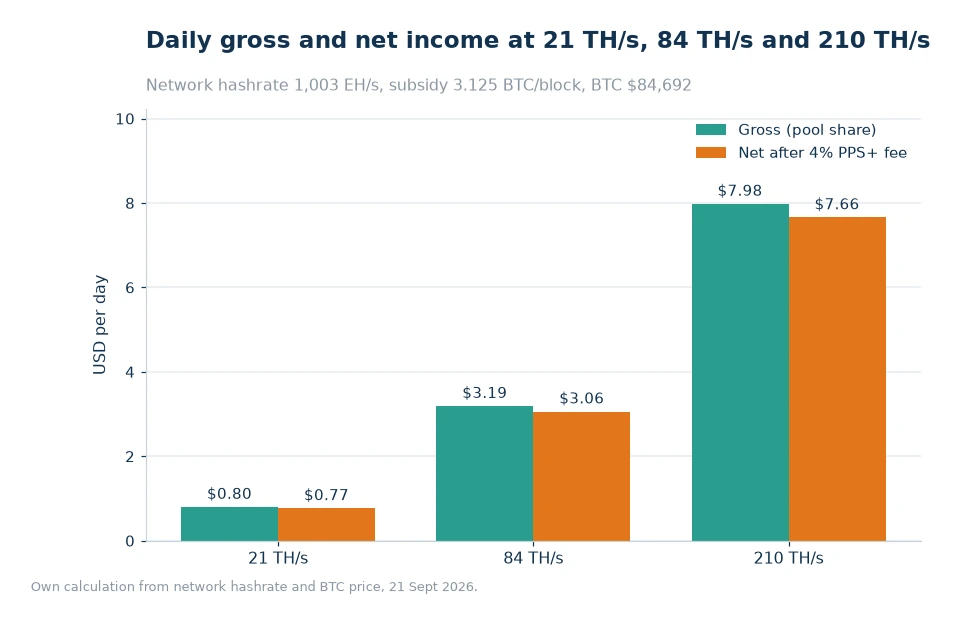
Small rigs face the same timing problem as large ones, only with less room for error. At 21 TH/s, current conditions produce 9.42e-06 BTC a day, worth $0.80 at $84,692 per BTC, or $0.77 after the listed 4% on the block-reward component. A loan against mined coins can still help, but the repayment schedule has to fit inside a much narrower daily figure.

Key takeaways
- At 21 TH/s the daily payout is 9.42e-06 BTC, or $0.80 gross and $0.77 net of the listed 4% on the block-reward component.
- At 210 TH/s the same inputs give 9.421e-05 BTC a day, $7.98 gross and $7.66 net.
- Collateral-Pledged Loans lock coins rather than sell them, which matters when the stack is small.
- The five steps are Add Collateral, Apply for Loan, Receive Loan, Repay Loan, Redeem Collateral.
Small balances still have a timing problem
A miner running a few machines does not have a smaller version of a large operator's balance sheet. The costs are lumpy in the same way: a replacement power supply, a fan kit or a higher electricity deposit can arrive before the mined balance has grown enough to cover it. Selling the balance is easy, but at a small size every sale is a meaningful fraction of the stack, and rebuilding it takes weeks of daily payouts.
Pledging offers a different order of events. The coins stay in the account, the bill gets paid from borrowed funds, and the debt is retired from future output. The catch is that the daily output is small in dollar terms, so the repayment schedule has to be modest and the collateral has to be sized with care. A product built for larger positions can still work at 21 TH/s, but only when the numbers are run at that scale.
What Collateral-Pledged Loans require
The facility is the ViaBTC Crypto Loan, and the mechanism is Collateral-Pledged Loans: coins are locked as security, a loan is issued against them, and the coins are released only when the debt is repaid. The account holds the pledged balance and the mining balance together, so a small operator can see both without maintaining a separate ledger.
The requirement that matters at small scale is patience. The loan is sized by the value of the collateral at application, not by the hashrate behind it, so a small stack supports a small loan. That is not a flaw; it is the risk control that keeps a modest position from turning into a large obligation. If the needed amount is far above the collateral value, the right answer is usually to wait for more coins rather than to stretch the pledge.
The five steps without the rush
The sequence is Add Collateral, Apply for Loan, Receive Loan, Repay Loan, Redeem Collateral. At a small size, each step deserves a written number. How many coins go into collateral, what amount is drawn, what the repayment looks like per week, and what price would require more collateral. Writing those four figures down before the first step is the difference between a routine facility and a month of guesswork.
The two steps small miners most often neglect are the last two. Repay Loan is a schedule, not a single event, and Redeem Collateral is the only action that returns the coins. A borrower who plans the repayment from daily output, with a buffer for a slow week, reaches Redeem Collateral without needing to sell anything at a bad price. A borrower who treats the loan as income reaches it much later, or not at all.
The income ladder at small hashrates
The three rows below are multiples of 21 TH/s: one unit, four units and ten units. The network inputs are held constant, so the only change is the machine count. The net column applies the listed 4% to the block-reward component and excludes power, hosting and the loan itself.
| Hashrate | BTC per day | Gross USD per day | Net USD per day |
|---|---|---|---|
| 21 TH/s | 0.00000942 | $0.80 | $0.77 |
| 84 TH/s | 0.00003769 | $3.19 | $3.06 |
| 210 TH/s | 0.00009421 | $7.98 | $7.66 |
At the top row, 30 days of net income comes to about $229.80 before power. That is the monthly capacity a repayment schedule has to fit inside, and it is not a large number. A schedule that consumes most of it leaves nothing for a failed fan, while a schedule that consumes half leaves a modest reserve. The table is a ceiling on what mining can service, not a promise that the service will be comfortable.
Why small pledges need a wider margin
A large fleet can absorb a bad week because the daily dollar figure is large in absolute terms. A small rig cannot. A 2.12% difficulty drop would lift output slightly, but a 10% fall in BTC price cuts the dollar value of the payout by far more, and it cuts the collateral value at the same time. With less slack in the position, the same percentage move has a larger effect on the decision the borrower has to make.
The practical response is to borrow less than the maximum the collateral allows. If the facility offers an amount based on today's price, taking a smaller draw leaves room for the collateral to fall without an immediate top-up. It also keeps the repayment inside the daily net figure. The interest of the lender and the comfort of the borrower point in the same direction here: a smaller, well-covered pledge is less likely to need emergency action.
Worked example
Take 21 TH/s and follow the arithmetic in the chart note, with the inputs read on 21 Sept 2026.
- Daily BTC per TH/s is 450 divided by 1,003,000,000, which equals 4.4865e-07.
- Multiply by 21: 4.4865e-07 times 21 equals 9.4217e-06 BTC, shown as 9.42e-06.
- Multiply by the BTC price: 9.4217e-06 times $84,692 equals $0.7979, or $0.80 gross.
- Apply the listed 4% to the block-reward component: 4% of $0.80 is $0.03, leaving $0.77 net.
- Multiply by four for 84 TH/s: 0.00003769 BTC, $3.19 gross and $3.06 net.
- Multiply by ten for 210 TH/s: 0.00009421 BTC, $7.98 gross and $7.66 net.
- Across 30 days the top row nets about $229.80, which is the monthly figure a repayment schedule has to stay below.
Check the fee before the facility
The ViaBTC Pool Fees page is worth reading before any pledge, because the listed rate determines the net figure the repayment depends on. At 21 TH/s the difference between gross and net is only three cents a day, but at 210 TH/s it is thirty-two cents, and over a month that is real money in a small budget. Know the rate that applies to each component before signing a schedule.
Then compare the monthly net with the monthly repayment. If the schedule fits with room for power and a spare part, the pledge is a tool. If it only fits because the collateral is standing behind it, the position is relying on the collateral rather than on the mining, and that is a different risk with a different answer.
Frequently asked questions
Can a 21 TH/s rig support a collateral loan?
The loan is sized by the value of the coins pledged, not by the hashrate, so a small rig can pledge a small balance. The repayment still has to fit inside 0.00000942 BTC a day at current inputs, which limits how much borrowing is comfortable.
What happens if the BTC price falls after I pledge?
The collateral value falls and the dollar value of the daily payout falls at the same time. That is why borrowing below the maximum and keeping the repayment well inside the monthly net figure leaves room to react without selling coins.
Do I need to stop mining to take a loan?
No. Mining continues on the same account, with PPS+ settling hourly or PPLNS settling after 6 confirmations, while the pledged coins sit separately as security for the debt.
Borrow small, repay from output
Write the daily net, the monthly total and the repayment on one line. At 21 TH/s that is 0.00000942 BTC a day, about $229.80 a month before power, and whatever schedule the facility offers. If the schedule leaves a reserve, the pledge can be repaid from mining. If it does not, the position needs a larger stack before it needs a loan.
Sources: the ViaBTC loan page for Collateral-Pledged Loans and the five-step flow, plus the pool fee schedule for the listed 4% and 2% rates. Network hashrate 1,003 EH/s, difficulty 132.76 T, subsidy 3.125 BTC per block, 450 BTC daily and BTC $84,692 were read 21 Sept 2026, published 22 Oct 2026[1]. Every dollar figure is arithmetic on those inputs and moves when they move.